My KYC Playbook
Tools and tactics I've used as a product manager to regularly speak with customers


There is one thing that pretty much the entire product management community agrees on but very few PMs actually do, and that’s regularly speak with customers. If you sift through all of the product management materials online you’ll find enough frameworks and templates for a lifetime. In my opinion, a lot of this is null and void if, you as a product manager, don’t know your customer (KYC). In this post, I overview the tactics I have used to engrain customer calls into my weekly routine.
Finding customers
The first significant challenge is finding customers to interview. Here are a few methods I’ve had success with.
Recruit from feedback
Customer feedback and complaints are a treasure trove of leads for customer interviews. As a PM you are already probably reviewing these, so why not reach out to these folks to discuss their feedback in greater detail?
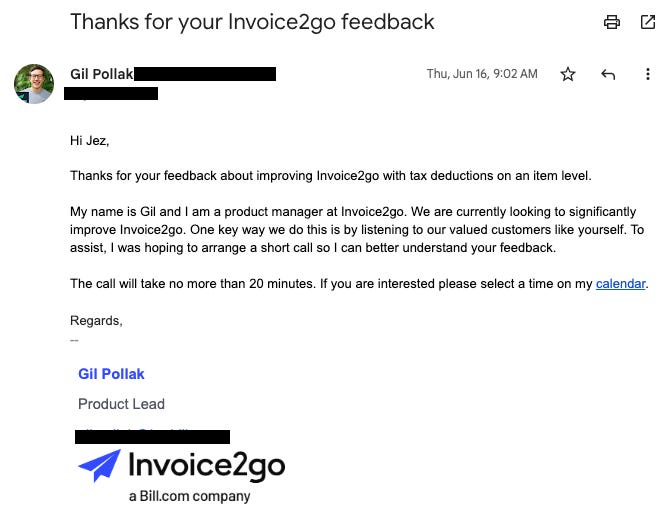
When I go through feedback I make sure to highlight interesting or relevant notes. Then I reach out via email, referencing their feedback. I’ve found this approach is much more effective in getting a response for a few reasons.
Firstly, by referring to their feedback in the outreach you have an organic introduction that removes the awkward nature of a cold email.
Secondly, if a customer has dedicated time to provide feedback it likely means they care about your product. So when someone responds to their feedback, especially a PM, they often can’t jump quick enough at the chance to have a conversation about the issue.
Recruit in App
In-app surveys also provide another great method to recruit users for customer interviews. These are particularly useful if you want to find users who’ve done a certain action or fit a specific profile. You can set up these surveys in minutes using tools like Hotjar or Pendo.
Iterate on your email
After I find the potential interviewees I reach out via email. I try to treat these emails like small campaigns, continually experimenting with different copy and subject lines with the goal to increase my response rate.
I’ve found personalization goes a long way. I always address the user's name and try to reference something specific about their feedback.
In addition, the time the email is delivered also impacts response rates. I’ve found morning or late afternoon emails on Tuesday to Thursday work best. I use the Gmail schedule send feature to ensure I always hit these windows, which is especially useful for customers in different time zones.
Finally, using a booking tool like Calendly is also a must to prevent those unbearable back-and-forth scheduling email chains that inevitably cause dropoff.
It’s a volume game
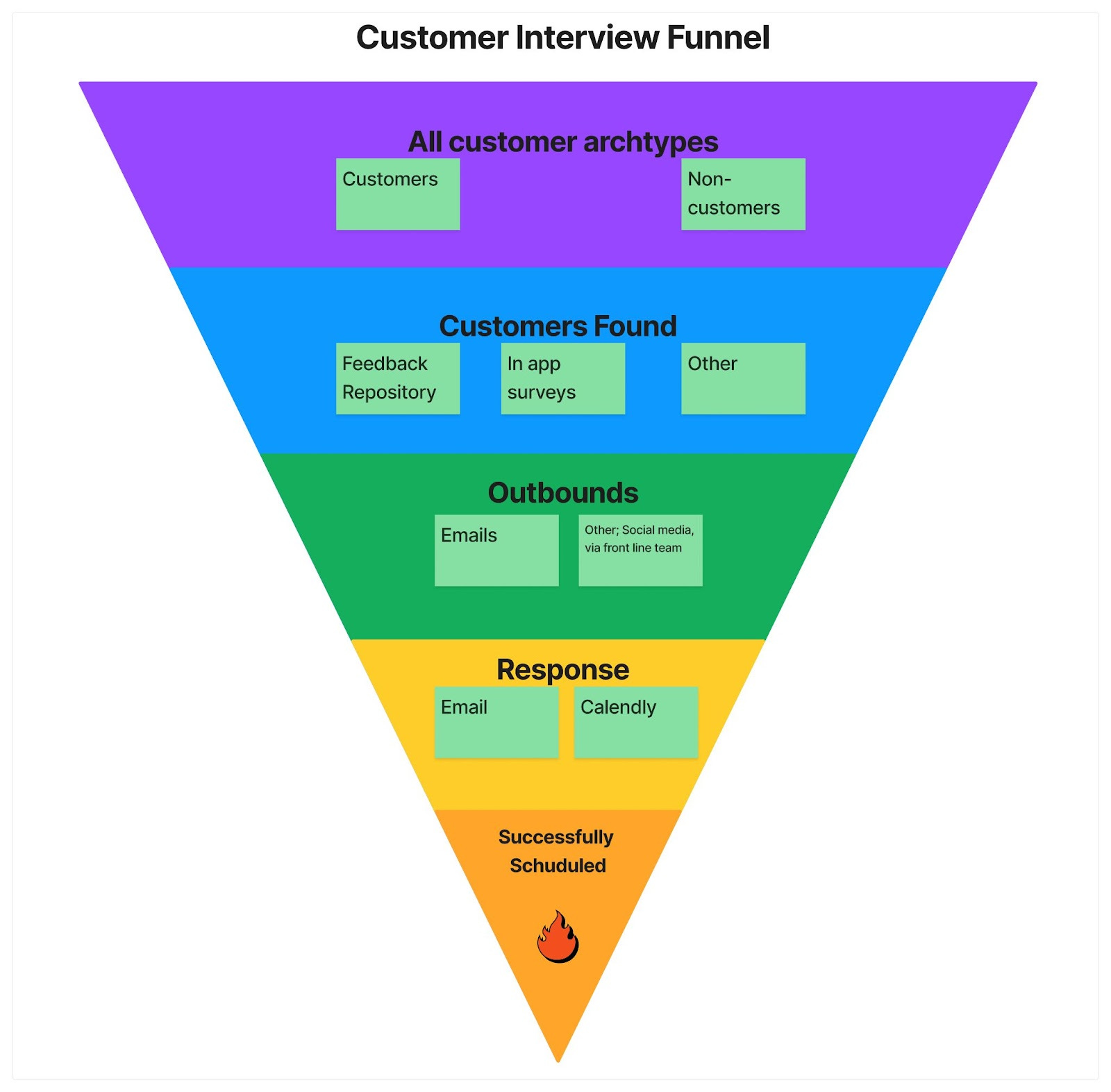
Even by following the above tactics, the majority of customers will still not respond to you. Most people are busy and have little time for an interview. I’ve found that if I reach out to 10-15 customers, I will usually get the chance to conduct 2 or 3 interviews. Accounting for this I block off time every week to send at least 10 outbounds.
Beware of Biases
One thing I’ve become more cognizant of is the bias throughout the entire interview process, in particular selection bias.
Any means I have used to select customers will have some bias in it. For example, if I find interviewees from a feedback repository my interview sample is probably skewed towards very pissed-off or happy users.
A technique I’ve used to counteract bias is to occasionally interview non-customers. People that fit your customer archetype but are not users of your product.
My view here is that I need to be conscious of the biases involved and try to find ways to alleviate them. However, I have never let the concerns around biases not deter me from speaking with customers.
During the Interview
Now that I’ve found and scheduled a call the next thing is to conduct the interview. Leading an interview can be daunting. I’ve developed a few techniques that gave me the confidence to conduct better interviews.
It’s Just a Conversation

While we may call it an interview, it should really feel like a conversation. I’ve noticed that if I focus too heavily on my interview plan it can lead to the call feeling rigid and impersonal. As a result, I prioritize listening and then asking naturally flowing questions rather than quickly shifting gears to the order of my interview guide. If the customer goes down a bit of a rabbit hole I don’t yank them back. Instead, I listen and let them say what they need to say. These holes are often where I have found some real gems.
Start Broad
Setting the tone at the start of the interview is critical. Often customers will want to go straight into their pet peeve about the product. However, I start by asking broad questions about the customer. This works to build rapport and that desirable conversational vibe.
At Invoice2go where I talk to small business owners, I ask them questions like:
What type of business do you run?
How long have you been in business?
Why did you start the business?
Who else works in the business?
When did you start using Invoice2go and why?
Multitasking is Hard
I find it very hard to write notes, listen and plan my next questions simultaneously, so I prioritize listening. The best way around this is to have a colleague hop on the call and take notes. However, if I don’t have that luxury I ask the interviewee for permission to record and utilize the Zoom transcribe feature.
Some don’t go to plan
I’ve had customer calls where the customer just wants to vent. In these cases, it’s just a matter of reading the room. I throw out my interview plan and just practice being a good listener.

Do Not Over Commit
Often customers will provide feedback and ask me directly when I will fix their problem. I’ve made the mistake of being put on the spot and then committing to improvements I shouldn’t have. Learning from this, what I’ve found helps is to have a prepared non-committal response (see example below).
I appreciate how this is a concern to you. I know my team is committed to improving the product and we are currently working hard on a variety of pressing matters. As such, I do not want to overcommit to fixing this issue before I do some further diligence and know for certain we can.
3 Post Interview Steps
The work doesn’t stop after when the interviewee hangs up. After the interview is where all the value is created. I’ve distilled my post-interview process into 3 steps below.
Review the Call
I like to review the call and start writing notes as soon as feasibly possible. This ensures the conversation is still fresh in my mind. Time permitting, it’s ideal to re-watch the call but if that’s not feasible a faster option is to read the interview transcript and make notes from there.
I also use a digital whiteboard tool (like Miro or Figjam) to map themes from my interviews. This visual representation enables me to see key trends. It also acts as an index for my interviews, which I can use to refer back to find key takeaways.
Share the findings
I always am sure to share my interview notes in a TLDR-friendly manner. After a call I post an update on Slack highlighting some key insights and then attach it to a Google doc with the interview’s goal, customer profile, key takeaways and transcript.
This allows everyone who couldn’t make the interview but are still interested to get as much info as they want from the call.
Get Feedback
Interviewing is a skill I am always striving to improve. After I take a call with colleagues I often ask them if there was anything I could have done better. My teammates have often seen things from a different angle and highlighted useful ways I can improve.
The Benefits
The benefits of speaking to customers regularly cannot be overstated. In fact, I attribute much of my career’s progress to prioritizing speaking with customers regularly. I’ve listed a few non-obvious benefits I’ve found below.
It’s Motivating As Hell
“If you’re changing the world, you’re working on important things. You’re excited to get up in the morning.” Larry Page
I often left a customer call insanely pumped up and motivated. Working in tech with our unlimited PTO, bottomless snacks and flexible schedules we are often living very different lives to our users. Speaking with the real people that rely on my product has enabled me to break down that ivory tower and bring the customer to the forefront of my team's work.
Product Gut
I’ve found that speaking to customers has helped develop what I call my ‘product gut’. The product gut my intuition I can rely on to make timely decisions (similar to what some call a Product Sense). Interviews combined with other qualitative and quantitative data provide the nourishment that enables me to continually improve my understanding of my users' motivations, how they use the product and the daily problems they face. This makes the challenge of multiple decisions each day much more bearable. (TBH I’m not entirely sure how many product decisions are made without speaking to customers…).

You Gain Cred
Speaking to customers is also probably one of the best and easiest ways to gain credibility. By regularly taking customer interviews and inviting others (specifically your engineers and designers) I’ve managed to quickly earn the trust of my team. This results in an understanding that the majority of my decisions are made with our customers in mind.
Makes you an asset
My conversations and customer knowledge have enabled me to stand out from the crowd. Before long I developed a reputation across the business as a key voice of the customer. This results in people coming to me with all sorts of questions and opportunities.
The gateway to becoming strategic
One thing I hear a lot from junior PMs is that they want to be more strategic. A key part of being strategic is understanding the link between business objectives and customer problems. By continually tracking customer problems, I was in a unique position to see overarching themes emerge. Pairing these insights with our business objectives I was soon able to propose more strategic opportunities.
Early adopter bench
Finding engaged users who are willing to become early adopters of new features can be tough. However, I have built a small bench of potential beta users through my calls. This has proven to be extremely valuable as it enabled me to rapidly test prototypes and other concepts.
I hope these tactics I’ve outlined help some PMs speak to customers more often. There is no doubt speaking to customers is time-consuming, confronting and hard. Getting first-hand insights from your users is something that needs to be explicitly prioritized and engrained otherwise it’s just too easy to get bogged down on other tasks. But in my experience, the investment has been well worth it.